W A R N I N G !


W A R N I N G !

This page is full of non-facts and bullsh!t, (just like the internet and especially forums and other blogs), please do not believe entirely without exercising your intellect. Any resemblance to real things in reality is purely coincidental. You are free to interpret/misinterpret the content however you like, most likely for entertainment, but in no case is the text written on this blog the absolute truth. The blog owner and Blogger are not responsible for any misunderstanding of ASCII characters as facts. *cough* As I was saying, you are free to interpret however you like. *cough*

Thursday, January 20, 2011

Ninja (heatsink) duct upgrade

I was cleaning up my table, computer included, so decided to take this chance to make a duct for it.

I really love the Ninja's design - a square heatsink that simply allows air to flow through itself as if it is not there.

It is a fairly efficient fanless heatsink, but a duct boosts its cooling capability by a lot without an extra fan.

So here's what I did:


Another angle:


Yup, I'm using both system and PSU fan to suck out the air through the Ninja. Might be a bit of overkill - just the PSU fan might be enough.

If the sensor is correct, I'm idling at room temperature with system fan @ 700rpm, and that's after Linpacking. While Linpacking it is room temperature + 15 (assuming the room temperature is 22), with fan at ~860rpm.

Thursday, January 13, 2011

SNR Savior


- Reduces noise level and increases SNR by allowing for higher source output levels
- Attenuates random noises as the signal passes through before entering the amp/receiver
- Shifts the amp/receiver's volume control from the problematic ~9-o'clock to ~12-o'clock to avoid channel imbalance issues at low volume positions
- Alleviate grounding-related noise issues with 11kohm impedance to ground seen by source and 1khom seen by load
- Uses pure silver wiring and Dale CMF 1% military grade resistors
- Amount of attenuation: 20dB

Monday, January 10, 2011

Coaxial S/PDIF-out from X-Fi XtremeGamer SPDIF_IO header

The low-profile X-Fi XtremeGamer is devoid of connectivity; but hey, which consumer soundcard isn't.

Apparently the connections of some newer high-end soundcards are becoming more bare than that of on-board sound, but I digress.


The SPDIF_IO header on my XtremeGamer has always interested me. I've been using this card's optical out but would prefer coaxial, and I needed a coaxial in for testing purposes.

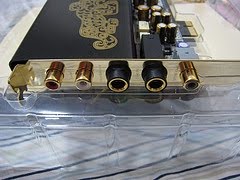
This is my actual card.


And this is the connector:


A bit of poking with the multimeter reveals this:


Considering the alignment of the +5V, Ground and 10k to ground pins, those are probably for the optical SPDIF-in. Or the 10k to ground pin could be something to connect to +5V to activate the other ground pins which are otherwise too numerous. Perhaps I should call them "mystery pins". At any rate, it does not work as coaxial SPDIF-in.

EDIT: After looking around other Creative cards with this connector, I came to a conclusion that, the unknown 10k to ground pin, is indeed SPDIF-in. However since it has a 10k load it will not work well with a 75-ohm coaxial cable source. A buffer or a source that can handle the load, like the electrical signal generated from the optical-in, Creative's drive-bay console whatever things, even SPDIF-out from the motherboard and CD-ROM drive should work - I haven't confirmed it myself yet but you can always try.

I didn't get the first prize but at least got the consolation prize. So all that's needed for coaxial SPDIF-out is pins 7 and 9. Digging through the box-o'-rubbish I came up with this contraption:


Fixed onto the card, center (signal) wire to pin 9, outer shell (ground) to pin 7.


Installed it into my com. Viola, it works.

Quote of the day:

"There's a term for those people who leech off society and then whine when their privilege is removed. I call them 'losers'."

Sunday, January 9, 2011

Yup, wood is still being expensive


1. Find a spirit level
2. Put it in an oversize block of wood
3. Sell it for $29

Tuesday, January 4, 2011

Faith typical values

"MINI PCM2704 HI-FI USB DAC SOUND CARD BOARD - XD

Description:

Brand new
compatible the USB 1.0 16bit support 32 KHz / 44.1khz / 48khz sampling

Dynamic range: 100dB

noise signal ratio: 105db (faith typical values) THD + N: 0.002%

Internal integrated independent 12MHz clock generator built-in 8 x Oversampling digital filter

Adopt double power supply.Analog part is + 5V , Digital parts for + 3.3 V"

http://cgi.ebay.com/MINI-PCM2704-HI-FI-USB-DAC-SOUND-CARD-BOARD-/170572980257?pt=LH_DefaultDomain_0&hash=item27b6f12021

Now now, how do you even get 100dB from 16-bit in the first place?

Answer is: You can't.

TI's datasheet also shows it maxes out at 98dB.

How "faith".