I'm going to start another series/category, this time being reviews on old things.
In these posts, I will look at old products, to find out 1) How good they really were in the past compared to other old alternatives, and 2) How good they are now compared to newer alternatives and whether they should continue to be used.
I may also be looking at some stuff that are not that old, but the hype has in my opinion died down. Wink wink. Well you'll see it when I post it.
Now lets move on to the meat of this post, starting with an old famous product.

Showing posts with label rmaa. Show all posts
Showing posts with label rmaa. Show all posts
Thursday, May 10, 2012

Saturday, March 24, 2012

Thursday, March 8, 2012

Thursday, February 9, 2012


Monday, January 16, 2012
PSP (fat) RMAA measurements
This is a bit late (okay, a lot late), but here are the RMAA results for the first PSP.
PSP max volume unloaded
PSP max volume 33Ω

Unloaded
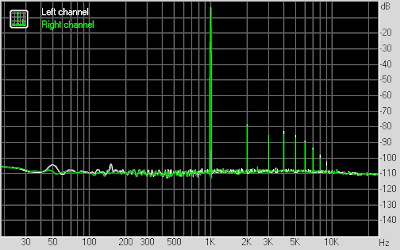
33Ω

Because I want to see if I'm going to get an improvement with what I'm going to do.
Oh, and the output impedance is about 15.8Ω. Kinda high for some earphones. My X10 sounds like this:

PSP max volume unloaded
PSP max volume 33Ω

(Ignore the crosstalk measurements because they are wrong!)
Unloaded

33Ω

Because I want to see if I'm going to get an improvement with what I'm going to do.
Oh, and the output impedance is about 15.8Ω. Kinda high for some earphones. My X10 sounds like this:

Tuesday, July 26, 2011
Muse M20 EX3 TA2021 amp - User review
Measurements
I finally got around to measuring this amp. And building the contraptions needed to measure amplifiers.

I finally got around to measuring this amp. And building the contraptions needed to measure amplifiers.

Thursday, May 26, 2011
Xonar DX RMAA


My new measurement card.
SGD$128 for this kind of performance. Some manufacturers should be ashamed.
The D2X is rated almost twice as good at twice the price. That is the card to go for if you have a bit extra moolah. For now, this is enough to help weed out the bad products.
Thursday, March 17, 2011
JDS Labs cMoyBB v2.03 Review: Measurements Section
Update: The measurement results for OPA2604 have been deemed invalid. Update on this here.

E-MU 0404 PCI - Detailed RMAA Results
The card I used to measure - E-MU 0404 PCI
Note that the first measurement is taken a long while back while the other two are taken on the day the cMoyBB is being measured and with the same setup, minus the cMoyBB of course. Also those voltage values are RMS voltages out from the E-MU 0404 line-out and into the E-MU 0404 line-in, which are the voltages at which the cMoyBB will be outputting for this review. The small things to be done that avoids false bad measurements of the thing to be measured.
For the above measurements the E-MU's output voltage is lowered by software, but counter-checking measurements show no appreciable decrease in performance figures. When feeding the cMoyBB, the E-MU is at max output.
Also note the strangely bad crosstalk numbers. This is because I only measured one channel (the left) and the right channel was duplicated from that one. Ignore those numbers for now. (Although you can also use it to find, not absolute numbers, the relative performance between the different things.) Or, you can look at the stereo graph versions.
The test
The cMoyBB will be tested in four conditions:
1) 1V into no load
2) 1V into 33ohm resistor
3) 0.2V into no load
4) 0.2V into 33ohm resistor
The voltages (in RMS) are chosen as such because 1V is the standard 0dBV line voltage, while 0.2V into 33ohm gives V^2/R = about 1mW of power into the load, and most ear/headphones' sensitivities are rated @ 1mW.
0.2V into no load acts as a control, to see how much of the distortion is caused by the 33ohm load.
Lower impedances require higher current draw, so 33ohm was chosen, and 1V into no load tests for scenarios where high voltage swings but low currents are needed for high-impedance headphones. Even for a 600ohm headphone, 1V into it yields 16.7mW, so unless its sensitivity is in the 80dB's and you have bad hearing, that is more than sufficient.
1V into 33ohm is a scenario you will never see in real life unless you want to destroy your earphones and/or your ear. But I'm including it anyway just to see how the amp handles such a scenario and how much headroom it has. But in the event of a fight-to-the-death between your earphones and your ear, my money goes to the earphones.
cMoyBB v2.03 - Default OPA2227

cMoyBB v2.03 OPA2227 - Detailed RMAA Results
cMoyBB v2.03 OPA2227 - Detailed RMAA Results - 0.2V into 33ohm
Starting off we have the cMoyBB v2.03 with its default op-amp OPA2227. Well, since this review is about the cMoyBB.
No load 1V and 0.2V give the same numbers as E-MU 0404 PCI, which means the performance of this amp is most likely better than what E-MU 0404 PCI can measure.

1V into 33ohm proved too much for the amp to handle with rocketing distortion numbers and huge signs of clipping, but even so it is below the 10% THD that many amp manufacturers like to rate their products at. Not that you should stand for that, but just saying.

0.2V/1mW into 33ohm, now we see much better numbers. However, compared to 0.2V without any load, we still can see some harmonic distortions that get significant from 10kHz and up. By significant, I mean there are more spikes that are still less than -100dB each in the audible frequency. Maybe you can hear a little bit more "detail", maybe not.
Notes on op-amp rolling
What's the use of the DIP socket if you're not going to roll op-amps?
So far I tried LM4562, LM6172, JRC4580, OPA2132, and OPA2604. LM6172 and JRC4580 have too high DC offset when used in this circuit, while LM4562 have around 20mV, which is high but still usable with care.
If in doubt, use FET-input op-amps.
LM4562

LM4562 - Detailed RMAA Results
LM4562 - Detailed RMAA Results - 0.2V into 33ohm
There seems to be some problem when measuring LM4562, which resulted in abnormal and fluctuating noise levels, which affected the distortions results to some extent. But you can always see the detailed results.
Unlike the OPA2227, the LM4562 had almost no problem driving the 33ohm load at 0.2V, with numbers close to the E-MU 0404's limits. Well, almost, because as you can see below, there is still some extra spiking at above 20kHz, and between 10 and 20kHz the spikes are taller than the EMU's, albeit by a few slightly audible dB's.
Known for its accuracy and price, the LM4562 would have been an ideal drop-in replacement in the cMoyBB if not for its DC offset, and some noise issues and frequency spikes that might have been caused by the noise. Needs to be retested when possible. Granted, it was not in a proper circuit for it anyway. But still, overall performance, minus the DC offset, is excellent.

OPA2132

OPA2132 - Detailed RMAA Results
OPA2132 - Detailed RMAA Results - 0.2V into 33ohm
Burr-Brown's "audio op-amp" pays a visit. "Audio grade" means bad performance on the whole, so there was not much expectation for it. On the other hand, OPA2227 is said to suck too, so there is hope for OPA2132 after all.

The distortion pattern from 10kHz onwards look similar to the OPA2227's, only smaller in magnitude. However between 1kHz to 10kHz there is much more lower-order harmonic distortion. Some may like the sound, some not, but in terms of accuracy, OPA2227 would come out ahead of the two.
OPA2604
Update: The measurement results for OPA2604 have been deemed invalid. Update on this here.

OPA2604 - Detailed RMAA Results
OPA2604 - Detailed RMAA Results - 0.2V into 33ohm
At SGD$6, this isn't much more expensive then the rest of the contenders. However, it's minimum rated supply voltage of ±4.5V is right on the voltage that a 9V alkaline battery can provide. I was slightly worried about this, but my worries proved unfounded.

The higher current output capability over LM4562 (35 vs 26mA) proved to be useful -no sign of clipping anywhere. Even though it was working at its lowest voltage limit. Well, I did read somewhere that the absolute lowest required is a bit lower. So it was not the TLE2426 that was bottlenecking. (It shouldn't, by right, because 0.2V / 33ohm = 6.1mA) But that also means all the other chips have a bit of current issues in this particular circuit, specifically, CMoys that are powered by a 9V battery pushing 0.2V into a 33ohm load. Further experimentation is required.
But then again, most of the shitz is above the audible range, so should it be cared?
Not only that, OPA2604 also gives a very nice hill of harmonics, highest at the better-sounding lower-orders, and decreasing as the order increase. OPA2132 did have something like that, but the gradient was less steep so there was more of the nasty higher-order. Also, OPA2604's hill is there even without any load, evident from the no load 1V test. It's as if OPA2604 synergized with this circuit to give a warm sound. Measured THD numbers are bad of course, but it may sound much better than what the numbers say.
A summary of the performance numbers (OPA2132 omitted):

Conclusion - cMoyBB
There are amps that measure bad, amps that are expensive, and amps that are both. With no-load @ 1V performance better than what the E-MU 0404 can measure, 33ohm @ 1mW just slightly worse, real-life usage can only result in even better numbers. At these numbers, the bottleneck is likely to be your whatever player if not headphones. Or, pop a suitable op-amp like OPA2604 in to change the sound while still retaining great performance. This thing definitely comes out great in the measurement grading, and the only reason I'm not giving it excellent is because it didn't get below E-MU 0404 performance while driving 33ohm @ 1mW. Though, with signs that it is the chip that is being the bottleneck, I doubt other similar designs using the same chip would do better. Or you can slap an AD8397 onto this amp, but do you really need that much output current while sacrificing the ability to roll op-amps to suite your taste in sound?
But you know, I'm an anal guy. So great, no excellent. And I blame it on bad initial op-amp choice. Wakakaka.
As for the price grading, I know of...... no portable amp that gives this type of performance for SGD$80. Those that probably do don't have measurements. Only many bad ones that cost less or around this price. Even if you go higher, there are some decent measurements of some amps but the measurements do not mention voltage and load, so it is difficult to judge.
Engineering is the art of compromise, and this amp did it right. Don't want output capacitors because they audibly and measurably add distortion, check. A TLE2426 instead of a bad resistor divider in order to avoid output capacitors, check. No need for extra current capability via ground buffer and certain op-amps (you can't do it without either), saving costs, check. The numbers don't lie, and this thing is perfect for most sane situations as a portable headphone amplifier. Sure, you can get better performance by paying more, and worse performance while paying less. But you don't really need higher performance, and you shouldn't stand for worse performance since it is easier to design an amp that performs better than a DAC (that includes portable players and soundcards - anything doing digital-to-analog conversion), so the amp should never be the bottleneck. And this thing smacks right at that point. Getting the job done right at the lowest price. Okay, maybe not really, I would've wanted slightly more current. But then again, that's the op-amp's fault.
So unless I find an amp that either 1) achieves the same performance for less money, or 2) achieves better for the same money, this thing will be at the top for value. And with measurements of other amps hard to come by, there is a lack of evidence to bring this guy down.
Conclusion - op-amp rolling
Being able to use only FET-input op-amps reduces op-amp choices, but there are many high-performance op-amps with FET-input.
LM4562 is the sure choice if you want clean and accurate, and if you can live with the DC offset. Changing some resistor values will solve that problem, I will need to look into that.
OPA2604 also works pretty nicely too if you want that kind of sound.
The default OPA2227 with its super low DC offset isn't bad either, with somewhat decent performance. But there might be better alternatives out there.
AD8397 (untested) might be a good choice, if you really need that current. You most likely won't, but hey.
Thursday, February 24, 2011
RMAA results of 16-bit/44.1kHz MP3 at various compressions
http://wwenze.netfirms.com/mp3.htm
I'm not going to do any explaining... too tired... sucks if you don't know how to read the graphs, go learn.
I'm not going to do any explaining... too tired... sucks if you don't know how to read the graphs, go learn.
Monday, December 13, 2010
Where you place your volume control - it matters
Self-loopback of recording interface (TASCAM US-144) -

Except the SNR of TASCAM US-144 is actually around 102-103dB; it is bottlenecked by its analogue out. Strange, I know.
High distortion values, probably from the mic preamp. Fortunately we're only looking at noise today.
Now, an explanation of all the candidates -
- DAC out (no volume control available), software volume control used, input of TASCAM US-144 @ max
- Preamp front headphone connector out, software volume control used, input of TASCAM US-144 @ max
- Preamp at volume required for 1dB, software volume control @ max. TASCAM input @ max
- Preamp @ maximum volume, software @ maximum volume, TASCAM input adjusted to get 1dB

Detailed results here:
Where you put your volume control - RMAA results
As you can see, even though my DAC and it's preamp stage is capable of over 100dB SNR (and possibly bottlenecked by the recording interface), if the input to the preamp is low volume noise gets amplified along with the tiny signal and kills SNR.
The second and third tests are to compare between using software to reduce to volume entering the preamp and using the potentiometer to achieve the same thing. As you can see, there is not much difference. The bottleneck is not the quantization noise that occurs at low digital volumes, but the huge 50Hz hum from the transformer plus other noises.
The first test is to test the typical scenario where one chooses to control volume at the digital source. For this, I put WDM volume @ 25/100 and master @ 6/100 in order to give -1dB with the TASCAM @ max volume. If those scales are linear, I would've lost around 6-7 bits of resolution and added some more noise, but the leftover signal can still theoretically do better than 81dB, which is full of mains hum.
So conclusion - do not output volumes too low from your source, or risk having noises from inside the source dominate.
Unfortunately, sometimes the default volumes of DACs are too loud, I have to put my Windows' volume @ 25/100 and 8-16/100 most of the time, even with my amp @ 9 o'clock.
But does that really matter?
Maybe, not really.
Sneak peek:

Subscribe to:
Posts (Atom)
